
Primordial Black Hole Formation in a Viscous Universe
Summary
Primordial Black Holes (PBHs) are a leading candidate for Dark Matter and serve as a unique probe of the extreme conditions of the infant Universe. While the standard framework typically models the collapsing cosmic medium as a perfect fluid with a constant equation-of-state, the formation of a PBH is a violent, highly non-linear process involving rapid compression and large velocity gradients. In our new paper arXiv:2606.26532, we move beyond the ideal fluid description to investigate how bulk viscosity - a natural dissipative correction in hydrodynamical systems — impacts the gravitational collapse and mass of resulting PBHs.
The Impact of Viscosity on Collapse
In the early Universe, bulk viscosity can arise from multi-component fluid interactions or particle production processes. To understand its effects, we performed fully non-linear numerical simulations using the BSSN formalism to solve the Einstein Field Equations. Our results show that dissipative effects qualitatively change the dynamics. In both collapsing and non-collapsing scenarios, bulk viscosity delays the propagation of outgoing sound waves and causes them to attenuate at a faster rate than in an inviscid fluid.
Particularly, these impacts on the critical threshold $\mu_c$ required for a perturbation to collapse into a black hole, yieldding to a higher threshold, therefore making PBHs harder to form. While viscosity “softens” the background expansion, which in principle would facilitate collapse, this effect is overpowered in the non-perturbative regime by the non-linear dynamical friction that opposes the collapse. Being the latter effect the dominant one, overall.
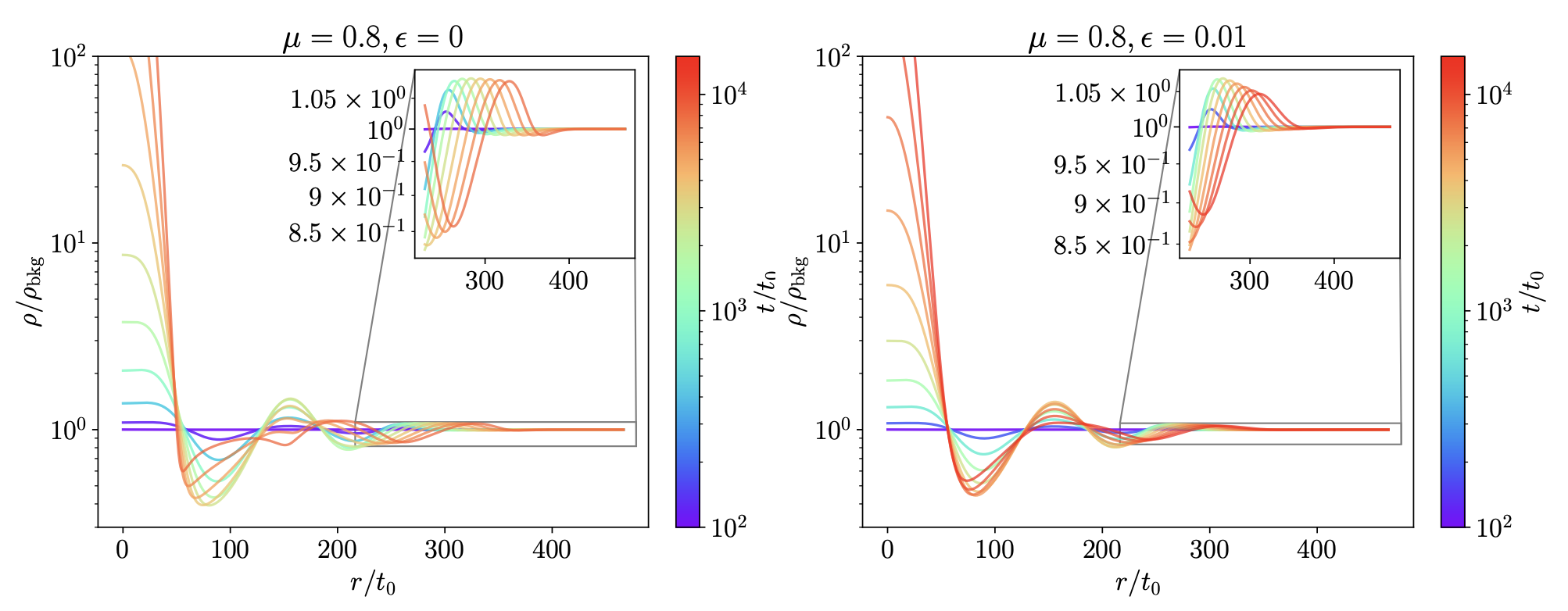
Collapse dynamics and dissipation in inviscid and viscous bulk cosmologies.
Mass Enhancement and Scaling Laws
We also investigated how viscosity modifies the resulting PBH mass function. Even in a viscous universe, the mass of a black hole near the critical point follows a standard scaling law.
\[M_{\rm PBH} \propto |\mu - \mu_c|^{\gamma},\]However, we found that bulk viscosity leads to an enhancement in the resulting PBH mass. The ratio of the PBH mass to the Hubble mass at horizon-crossing is increased by an order-one factor. This occurs partly because the viscous background speeds up cosmic expansion, causing horizon-crossing to happen earlier than it would in an inviscid case.
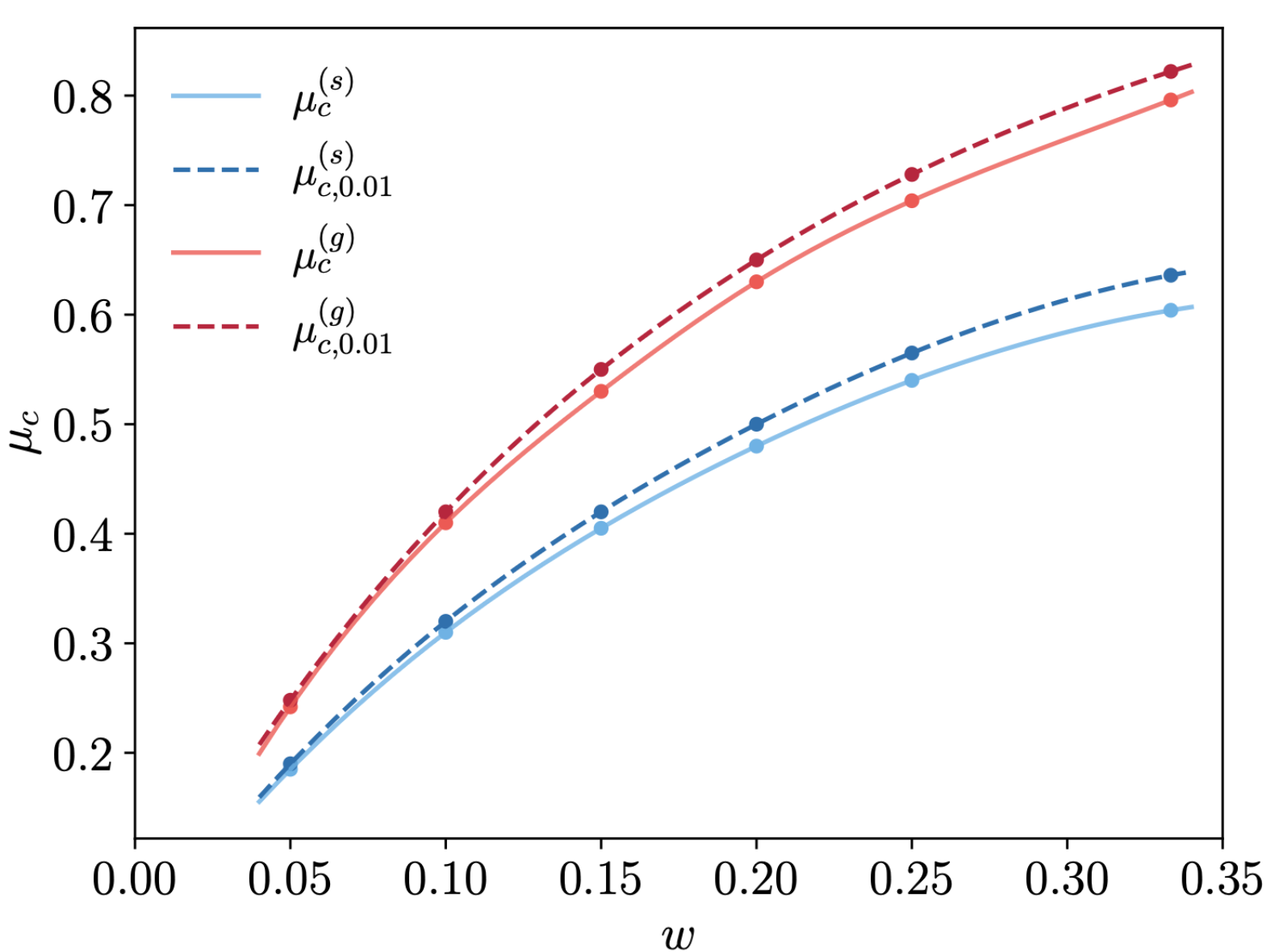
Threshold in inviscid and viscous cosmologies in respect to the fluids' equation of state ($\omega$).
Outlook
These results demonstrate that dissipative processes like bulk viscosity can systematically modify the PBH mass spectrum and formation probability. This adds a new layer of complexity to interpreting potential PBH signals in future observations from LISA and Pulsar Timing Arrays. Future work will aim to extend these simulations to 3+1 dimensions to explore how viscosity influences the spin and ellipticity of black holes during non-spherical collapse.
Stay tuned for more updates on phenomenology from the early Universe!
References:
1) ZY Yuwen C. Joana, SJ Wang, RG Cai (2026), Primordial Black Hole Formation in a Viscous Universe. arXiv:2606.26532
2) E. Bagui et al. [LISA Cosmology Working Group], “Primordial black holes and their gravitational-wave signatures”, Living Rev. Rel. 28, 1 (2025)
