
Primordial Black Holes from Finite-Width Spectra in a Stiff Universe
Summary
Primordial Black Holes (PBHs) can form when unusually large curvature perturbations re-enter the Hubble horizon and collapse under their own gravity. The same perturbations also generate a background of scalar-induced gravitational waves (SIGWs). PBHs and gravitational waves therefore provide two complementary views of the small-scale primordial Universe, which is otherwise difficult to probe.
The standard description of this process often relies on two simplifying assumptions: the primordial power spectrum is nearly monochromatic, and collapse occurs during radiation domination. However, in more generic inflationary sceneratios, enhancement generally extends over a range of scales, while the expansion history between inflation and Big Bang Nucleosynthesis may include epochs with an equation of state different from that of radiation.
In our new paper arXiv:2609.07043, we relax both assumptions. We consider a log-normal enhancement of the curvature power spectrum with finite width $\Delta$, and allow PBH formation during an epoch with equation of state $\mathrm{w}\geq1/3$. Using full Numerical Relativity (NR) simulations, we determine the collapse thresholds and use them to compute the PBH abundances and the associated SIGW signals.
Throughout this work, we assume Gaussian curvature perturbations and spherical symmetry. This allows us to isolate the effects of the spectral width and the background equation of state before adding further complications such as non-Gaussianity. Including non-gaussian effects, is a topic left for future works.
The Shape of the Primordial Spectrum
We describe the curvature power spectrum as
\[\mathcal{P}_\zeta(k) = A_s\left(\frac{k}{k_\star}\right)^{n_s-1} + \frac{A}{\sqrt{2\pi}\,\Delta}\,\exp\!\left[-\frac{\ln^2(k/k_p)}{2\Delta^2}\right].\]The first term is the nearly scale-invariant spectrum observed on large scales. The second is a small-scale enhancement centered at $k_p$, with integrated amplitude $A$ and width $\Delta$. In the limit $\Delta\to0$, we recover the monochromatic approximation. For finite $\Delta$, however, the power is distributed over many wavenumbers. At fixed $A$, increasing the width therefore lowers the peak of the spectrum.
This width also changes the typical spatial profile of a collapsing perturbation. To determine whether such a profile forms a PBH, we use the compaction function, which measures the excess mass enclosed within a given radius. For a curvature profile $\zeta(r)$, it can be written as
\[\mathcal{C}(r)=f(\mathrm{w})\left(1-\left[1+r\zeta'(r)\right]^2\right), \qquad f(\mathrm{w})=\frac{3(1+\mathrm{w})}{5+3\mathrm{w}}.\]The threshold for collapse depends not only on the amplitude of the perturbation, but also on the shape of this function. Broader spectra produce flatter compaction peaks, making collapse more difficult. Increasing $\mathrm{w}$ has a similar effect on the required amplitude, since a stiffer fluid provides stronger pressure resistance.
We performed NR simulations for five widths, $\Delta=0.1,0.3,0.5,1,2$, and five equations of state, $\mathrm{w}=1/3,1/2,2/3,5/6,1$. For each case, we varied the profile amplitude $\mu$ until we found the boundary between perturbations that disperse and those that collapse. The resulting threshold increases from $\mu_{\rm th}\simeq0.62$ for the narrowest spectrum in radiation domination to $\mu_{\rm th}\simeq1.04$ for $\Delta=2$ and $\mathrm{w}=1$. The corresponding critical peak compactions range from $\delta_c\simeq0.54$ to $0.71$, showing that there is no single universal collapse threshold.
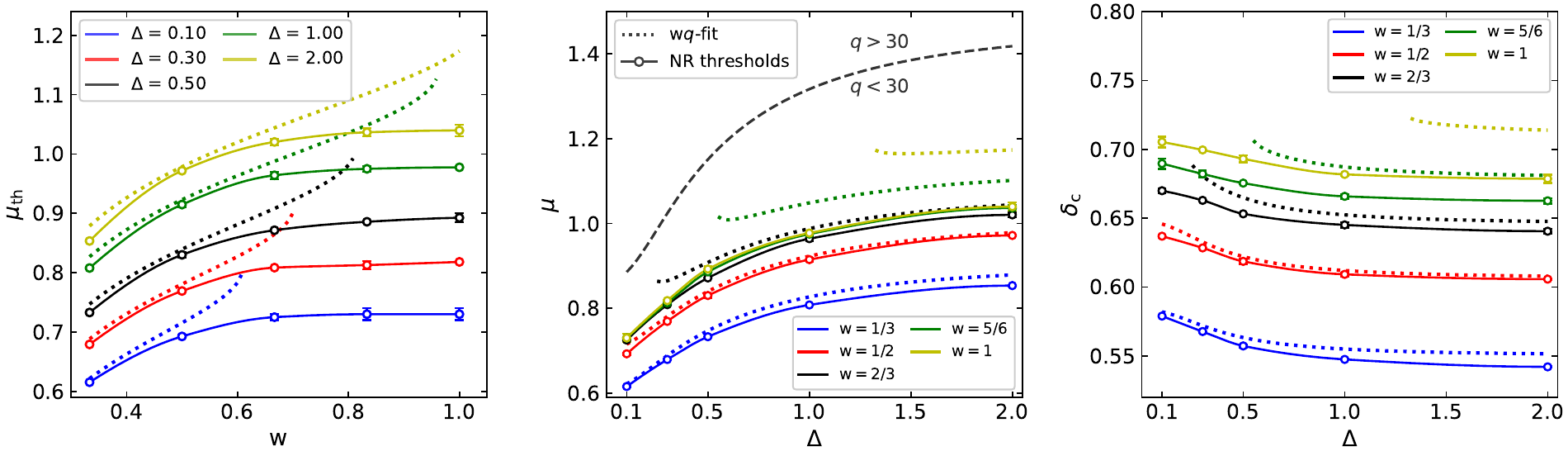
Fig. 1 Collapse thresholds obtained from NR simulations, compared with the semi-analytical $\mathrm{w}q$-prescription. The threshold amplitude increases with both the spectral width and the stiffness of the background.
We also compared these numerical results with two calibrations of the semi-analytical $\mathrm{w}q$-prescription. These can be useful estimates, particularly close to radiation domination, but their accuracy deteriorates for broad spectra and stiff backgrounds. In some cases, one calibration does not produce a threshold at all. Even when the estimated threshold differs by only a few percent, the predicted PBH abundance can change by orders of magnitude because their statistics depend exponentially on the collapse threshold. For this reason, we use the NR thresholds in all our calculations for abundances and related SIGWs signals.
PBH Abundances and Mass Functions
Once the amplitude exceeds the threshold, the PBH mass follows the critical-collapse relation
\[M_{\rm PBH}=M_H\,\mathcal{K}\left(\mu-\mu_{\rm th}\right)^{p(\mathrm{w})}.\]The critical exponent depends on the equation of state, increasing from $p\simeq0.36$ in radiation domination to $p\simeq0.92$ in the stiff limit. Thus, both the probability of collapse and the masses of the resulting black holes depend on the thermal history.
For our numerical examples, we choose $k_p=1.56\times10^{13}\,\mathrm{Mpc}^{-1}$ and $k_{\rm rh}/k_p=0.01$, where $k_{\rm rh}$ marks the transition to radiation domination. The corresponding horizon masses are around $10^{20}$–$10^{21}\,\mathrm{g}$, within the asteroid-mass window where PBHs may constitute all of the dark matter.
Figure 2 shows the effect of changing the equation of state while keeping the primordial spectrum fixed. In each panel, $A$ is chosen so that PBHs constitute all of the dark matter in radiation domination. As the background becomes stiffer, the higher collapse threshold strongly suppresses the total abundance. The mass function also shifts toward smaller masses in units of the horizon mass.
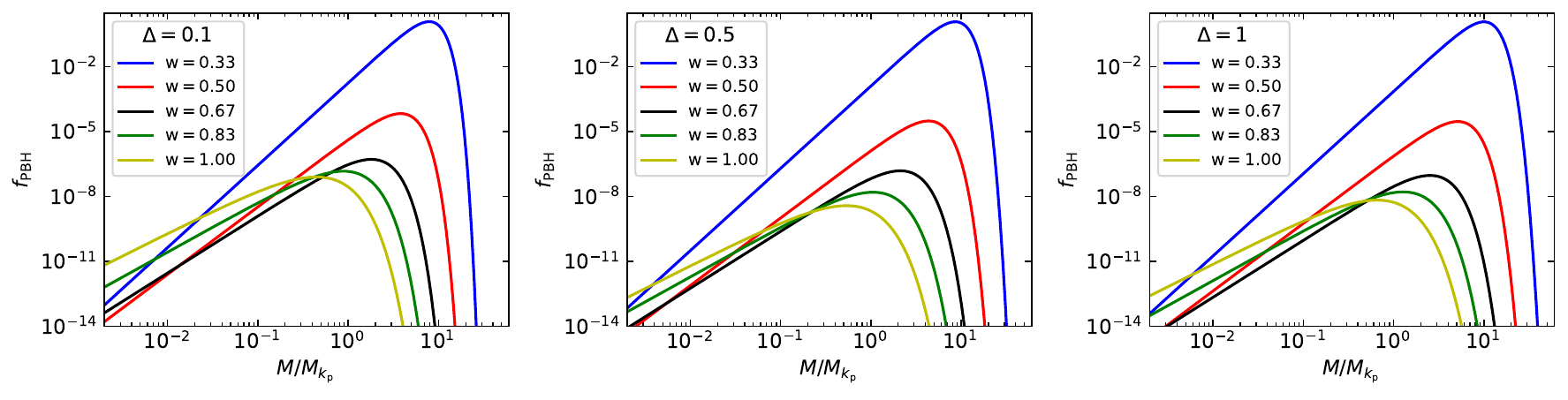
Fig. 2 PBH mass functions for three spectral widths. The amplitude is fixed to give $f_{\rm PBH}^{\rm tot}=1$ at $\mathrm{w}=1/3$ and then kept unchanged as $\mathrm{w}$ increases.
Gravitational Wave Signatures
The curvature perturbations that source PBHs also generate gravitational waves at second order in cosmological perturbation theory. Importantly, all sufficiently large perturbations contribute to this signal, not only the rare peaks that collapse into black holes.
For the scales considered here, the curvature-spectrum peak corresponds to a frequency of approximately $f_p\simeq2.4\times10^{-2}\,\mathrm{Hz}$, within the LISA band. The shape of the SIGW spectrum retains information about both $\Delta$ and $\mathrm{w}$. A broader primordial spectrum produces a broader gravitational-wave peak and a more extended high-frequency tail. A stiffer background enhances the signal and modifies its infrared behaviour, with the leading slope above the reheating scale approaching $\Omega_{\rm GW}\propto k^2$ as $\mathrm{w}\to1$, instead of the familiar cubic slope in radiation domination.
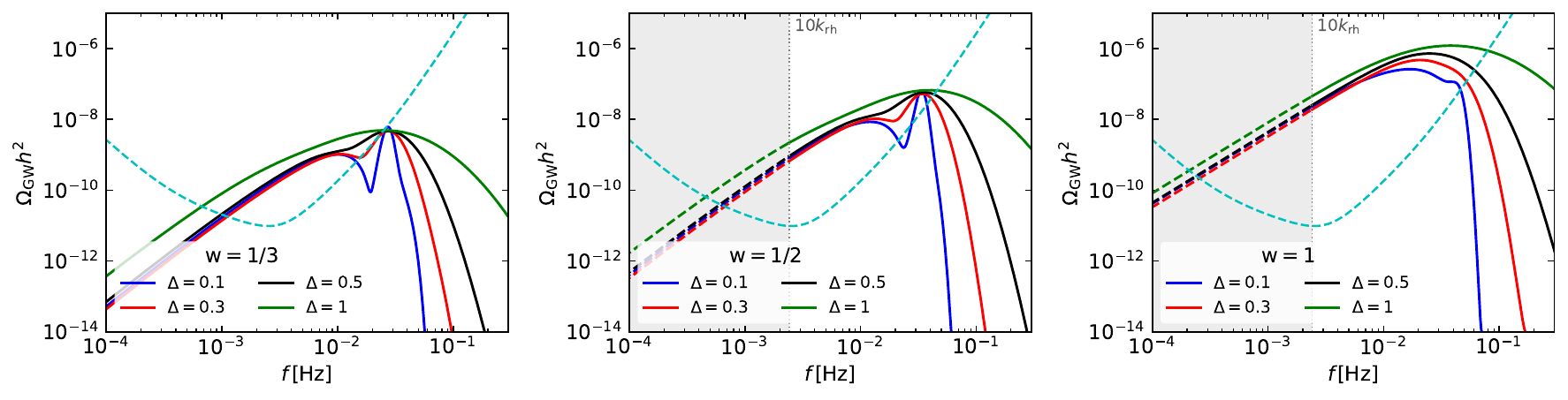
Fig. 3 SIGW spectra normalized to unit PBH abundance, together with the LISA sensitivity curve. The shaded region lies close to the reheating scale, where the constant-$\mathrm{w}$ calculation is extrapolated.
The low-frequency part of these spectra requires some caution. Our constant-$\mathrm{w}$ kernel applies to modes well above the reheating scale and does not include a full matching through the transition to radiation domination. The peak and the tails above reheating nevertheless show that measuring the shape of the signal, rather than only its amplitude, could help distinguish the width of the primordial spectrum from the expansion history.
The gravitational-wave background also provides an additional constraint. Its total energy contributes to the effective number of relativistic species, $\Delta N_{\rm eff}$. For the adopted reheating scale and unit PBH abundance, the broadest stiff examples exceed the CMB bound. In particular, at $\mathrm{w}=1$ we find $\Delta N_{\rm eff}^{\rm GW}\simeq0.52$ and $2.19$ for $\Delta=1$ and $2$, respectively, compared with a bound of approximately $0.3$. These cases are therefore not viable all-dark-matter scenarios under our assumptions.
Ending Note
The main lesson is that the width of the primordial spectrum and the equation of state at horizon re-entry are not secondary details. Together, they control the collapse threshold, the PBH mass function and abundance, and the associated gravitational-wave signal. A monochromatic spectrum in radiation domination can miss much of this phenomenology.
There are several natural extensions of this work. One is to follow the SIGW signal explicitly through reheating, allowing the low-frequency spectrum to constrain the duration of the non-standard epoch. Another is to include primordial non-Gaussianity, which modifies both the statistics of rare peaks and their spatial profiles. Connecting these ingredients to concrete inflationary and post-inflationary models will be essential for interpreting future observations.
Stay tuned for the next updates!
References:
-
A. Mohammadi, Yogesh, C. Joana, H. Tan, Y. Zhang (2026), Primordial Black Hole Abundances and Scalar Induced Gravitational Waves from Finite-Width Power Spectra in a Stiff Thermal History. arXiv:2609.07043
-
R. Inui, C. Joana, H. Motohashi, S. Pi, Y. Tada, S. Yokoyama, Primordial black holes and induced gravitational waves from logarithmic non-Gaussianity, JCAP 03 (2025) 021, arXiv:2411.07647
-
A. Escrivà, C. Germani, R. K. Sheth, Analytical thresholds for black hole formation in general cosmological backgrounds, JCAP 01 (2021) 030, arXiv:2007.05564
