
Three Paths to Primordial Black Holes during Kination
Summary
Primordial Black Holes (PBHs) are commonly associated with large positive curvature perturbations that collapse after re-entering the Hubble horizon. However, predicting their formation requires more than the amplitude of the primordial power spectrum. The full spatial profile of each perturbation and the expansion history at collapse also play an essential role.
In my new paper, Primordial black holes forming during kination: the trapped, the overdense, and the void arXiv:2607.20423, I follow the complete process using Numerical Relativity (NR): from an initially sub-Hubble fluctuation of the inflaton, through its nonlinear amplification during ultra-slow-roll (USR) inflation, to its re-entry and collapse during kination. Kination is an epoch dominated by the kinetic energy of the scalar field, with equation of state $\mathrm{w}\simeq1$.
The main result is that a single inflationary model can produce PBHs through three qualitatively different channels:
- a sufficiently delayed region remains trapped in inflation and becomes hidden behind a horizon in a bubble-like collapse;
- a moderately delayed region generates a positive-curvature overdensity, which collapses after Hubble re-entry;
- an advanced region generates a negative-curvature void surrounded by an overdense shell, whose implosion drives an overdense rebound at the centre and can also form a PBH.
These are not simply different amplitudes of the same collapse problem. They have different formation mechanisms and require separate statistical treatment when computing PBH abundances.
From Inflaton Fluctuations to Curvature Profiles
I consider a single-field inflationary potential with a slow-roll plateau and a small Gaussian feature. The feature briefly slows the field, producing a transient USR phase during which curvature perturbations are strongly amplified. The field subsequently enters a kinetically dominated regime. The potential is normalised to reproduce the observed CMB amplitude, while generating a small-scale curvature enhancement of order $\mathcal{A}_\zeta\simeq0.01$.
The initial data consist of localised, initially sub-Hubble scalar-field fluctuations. I solve the coupled Einstein–Klein–Gordon equations in spherical symmetry, continuously following each configuration through slow roll, USR and kination. Unlike the usual two-step approach, the curvature profile used for collapse is not prescribed by hand: it is generated by the same nonlinear evolution.
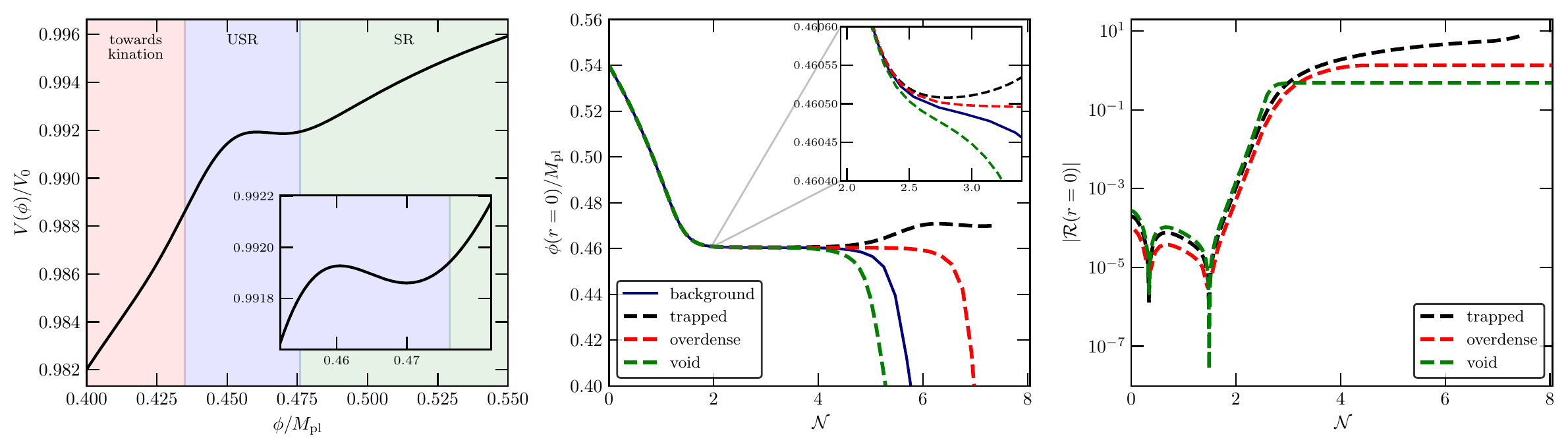
Fig. 1 Left: inflationary potential with slow-roll, USR and kination stages. Centre: evolution of the central scalar field for the three channels. Right: nonlinear amplification of the central curvature perturbation.
The sign and magnitude of the field displacement at the SR–USR transition determine the outcome. A large positive displacement delays the field enough for the central region to remain trapped near a shallow minimum of the potential. A smaller delay produces a frozen positive-curvature profile. A negative displacement instead advances the field and produces a void with a compensating overdense shell.
For the overdense and void configurations, the curvature perturbation becomes approximately conserved on super-Hubble scales. Its final radial shape can differ substantially from the analytic sinc profile often used as a template in PBH calculations. This deformation is important because collapse is sensitive to the complete profile, not just to its central value.
Three Ways to Form a Black Hole
In the trapped channel, the central patch continues inflation while its surroundings enter kination. The growing contrast between the two regions eventually hides the inflating patch behind a black-hole horizon, similarly to false-vacuum-bubble collapse. This is not an ordinary Hubble-re-entry process, so the usual near-threshold overdensity scaling does not apply.
The overdense channel is closer to the standard PBH picture, but with an important difference: the collapsing profile has been dynamically generated by the preceding inflationary evolution. The resulting threshold therefore cannot automatically be inherited from a sinc-profile calculation.
In the void channel, the underdense core initially expands faster than its surroundings. Matter accumulates in a surrounding shell, which subsequently contracts. The inward pressure gradient on its inner face drives the shell towards the centre, producing an overdense rebound. If this rebound becomes sufficiently compact, it forms a PBH. Here, the shell rather than the negative central curvature carries the essential collapse information.
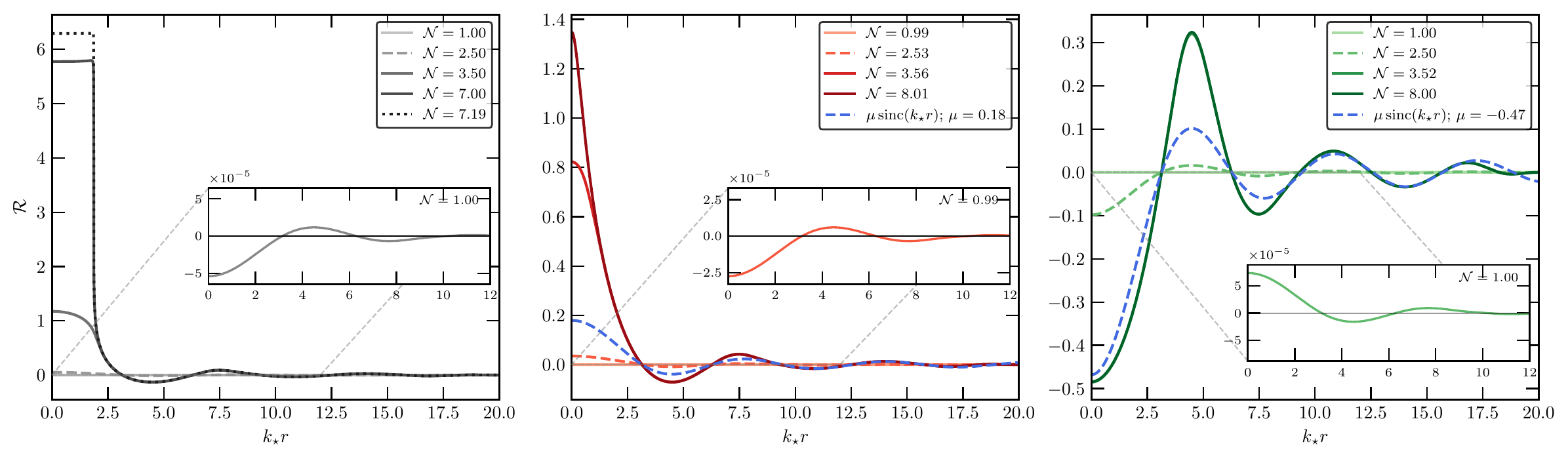
Fig. 2 Evolution of the curvature profiles for the trapped (left), overdense (centre) and void (right) configurations. Darker curves correspond to later times; dashed blue curves show sinc-profile references.
Collapse Thresholds Depend on the Profile
To quantify the importance of the profile deformation, I performed dedicated threshold scans for the frozen profiles extracted from the nonlinear evolution and compared them with sinc profiles. A useful diagnostic is the linear compaction function, which measures the excess mass associated with the curvature profile,
\[\mathcal{C}_{\rm lin}(x)=-2f(\mathrm{w})\,x\,\partial_x\mathcal{R}, \qquad f(\mathrm{w})=\frac{3(1+\mathrm{w})}{5+3\mathrm{w}},\]where $x=k_\star r$ and the thresholds are evaluated during kination, with $\mathrm{w}=1$.
For the overdense case, the critical central amplitude increases from $\mathcal{R}_c\simeq0.65$ for the sinc profile to $1.220$ for the generated profile, a shift of about $88\%$. The peak linear compaction changes much less, by approximately $19\%$. For the void, the magnitude of the central threshold decreases from $1.02$ for the sinc profile to $0.432$ for the generated profile, a shift of about $58\%$, while the peak compaction changes by around $11\%$.
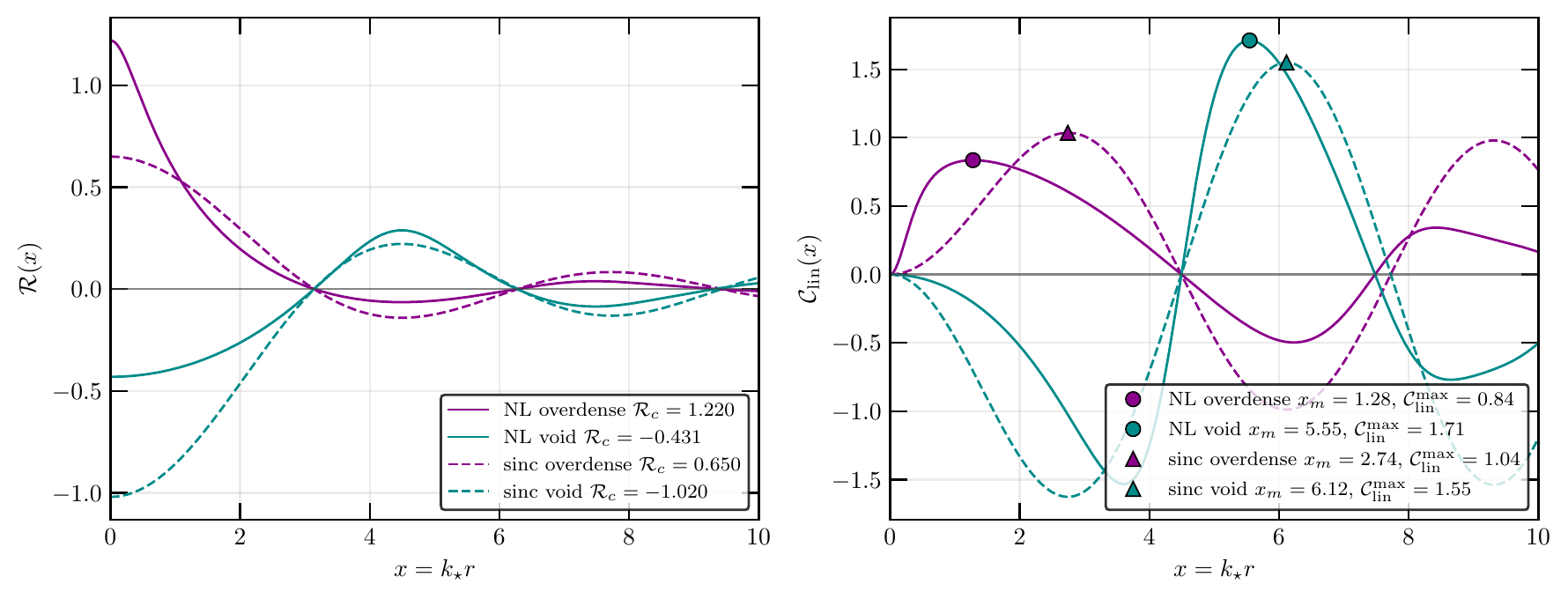
Fig. 3 Critical curvature profiles (left) and their linear compaction functions (right), comparing the nonlinearly generated profiles with sinc references.
The peak compaction is therefore a more stable first diagnostic than the central curvature, but it is still not universal. Its critical value depends on the profile, the formation channel and the background. For the same sinc profiles, I also find collapse thresholds in scalar-field kination approximately $10\%$ below those of an ideal stiff fluid when expressed in terms of peak compaction. This difference is associated with the anisotropic stress of scalar-field gradients, which softens the effective pressure response.
Early PBH Domination and Reheating
Both the overdense and void examples form apparent horizons containing a few per cent of the Hubble mass. Their subsequent masses grow appreciably as secondary and tertiary shells accrete onto the central black hole. The void remnant forms later and with a larger mass in the examples studied. These simulations establish the early growth history; longer near-threshold evolutions are still needed to determine asymptotic masses and critical mass scaling.
This formation scenario also has an interesting connection to reheating. In runaway potentials, the inflaton does not oscillate around a minimum, so the usual parametric and tachyonic preheating mechanisms aren’t pressent. Meanwhile, PBHs redshift as matter, $\rho_{\rm PBH}\propto a^{-3}$, whereas the kination background dilutes much faster, $\rho_{\rm kin}\propto a^{-6}$. Even a small initial PBH abundance can therefore grow in relative importance, and Hawking evaporation may therefore provide another way to reheat the Universe.
Follow-up
The main lesson is that PBH formation in non-attractor inflationary models should be described in terms of a distribution of complete curvature profiles. A one-point distribution of the central curvature, combined with a threshold calibrated on a fixed analytic profile, can miss both the profile deformation and entire formation channels.
The next step is to determine the probability distribution of the generated profiles and map the collapse conditions for trapping, overdense collapse and void-shell collapse separately. Also, further works will include longer simulations to distinguish critical scaling from environmental accretion, three-dimensional studies of stability beyond spherical symmetry, better computations of mass functions, and calculations of the associated gravitational-wave signals.
Until the next update!
References:
-
C. Joana (2026), Primordial black holes forming during kination: the trapped, the overdense, and the void arXiv:2607.20423.
-
C. Joana, Z.-Y. Yuwen, Primordial black holes from primordial voids, Phys. Rev. D 113, 023518 (2026), arXiv:2510.11611.
-
G. Domènech, J. Tränkle, From formation to evaporation: Induced gravitational wave probes of the primordial black hole reheating scenario, Phys. Rev. D 111, 063528 (2025), arXiv:2409.12125.
